Mountain E-Bike
Mountain E-Bikes for Trails and Climbing
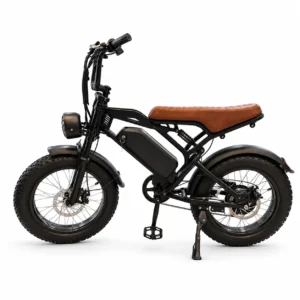
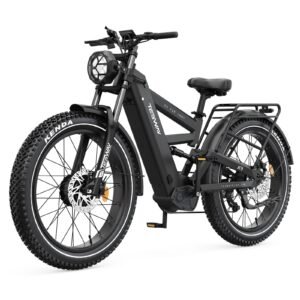
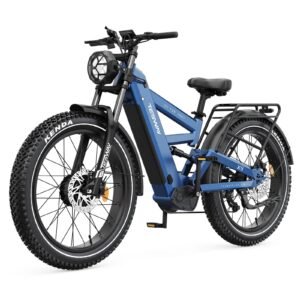
A mountain e-bike pairs high-torque motors with real suspension to climb steep grades and descend rough trails. Our lineup runs from $1,050 to $1,840. Torque matters more than watts here: the ENGWE Eagle Electric Dirt Bike ($1,050) delivers 220 Nm through a 3,200W peak mid-drive, while the dual-motor Tesway X7 AWD Dual-Motor Fat-Tire Electric Bike ($1,655.99) and Tesway X9 Ultra Dual-Motor All-Wheel-Drive Electric Bike ($1,747.99) bring up to 4,000W peak. Check trail access rules before you ride.
Showing all 4 results
-
E-Bikes, Adults E-Bike, Commuter E-Bikes, Mountain E-Bike
$1,499.99Select options This product has multiple variants. The options may be chosen on the product page



Showing all 4 results
What Makes a Mountain E-Bike Different?
Torque and suspension. A commuter motor moves you along; a mountain motor drags you up a loose 20% grade without stalling. And when the trail points down, suspension keeps your wheels on the ground instead of bouncing you off line.
Two philosophies live on this page. Mid-drives like the ENGWE Eagle ($1,050, 3,200W peak mid-drive, 220 Nm) drive through the gears, so they climb like a mountain goat and stay efficient. Dual-motor brutes like the Tesway X7 AWD ($1,655.99, 3,600W combined peak) and Tesway X9 Ultra ($1,747.99, up to 4,000W peak, 240 Nm) simply overpower obstacles. Both work; pick your religion.
Suspension: What You Actually Need
Front suspension is the minimum for real trail riding. Full suspension adds a rear shock that keeps the back wheel tracking over roots and rocks, which means more traction climbing and more control descending.
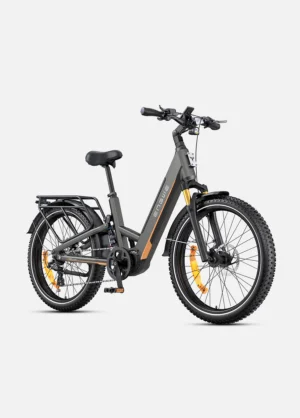
Every model here runs full suspension. The ENGWE E26 3.0 pairs it with 26×3-inch all-road tires for a lighter, pedal-friendly trail feel, though it is currently out of stock. The Tesway dual-motors use long-travel setups built for their 100+ lb weight.
Torque, Explained Honestly
Newton-meters (Nm) decide climbing; watts decide speed. A 250W mid-drive with 100 Nm out-climbs a 1,000W hub motor with 60 Nm on a steep grade, because torque is twisting force at the wheel.
Reference points from this page: the Eagle’s 220 Nm and the X9 Ultra’s 240 Nm are enormous, enough for gradients that defeat most riders’ legs entirely. If your trails are steep and loose, shop by torque first.
The Lineup
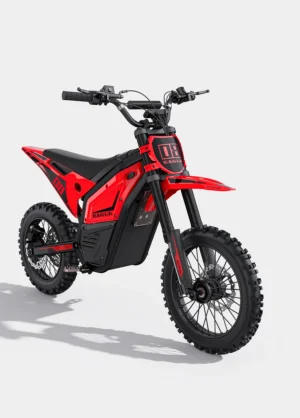
Maximum climb: the ENGWE Eagle Electric Dirt Bike ($1,050). 3,200W peak mid-drive, 220 Nm, ~1,404Wh battery, 45 mph top speed, full suspension. A dirt bike with pedals, essentially.
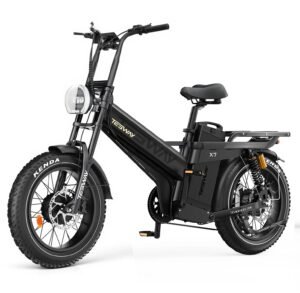
Maximum range: the Tesway X7 AWD ($1,655.99). 3,120Wh battery for up to 200 miles of pedal-assisted range, dual motors, 400 lb payload. The expedition choice.
Maximum power: the Tesway X9 Ultra ($1,747.99). Dual 2,400W rated motors, 4,000W peak, 240 Nm, 43 mph, 26×4-inch fat tires. Nothing on this page out-muscles it.
Trail Access: Read This Before You Ride
Not every trail allows electric bikes. US trail systems classify e-bikes by the three-class system, and many singletrack networks restrict even Class 1. High-power models like the Eagle, X7, and X9 Ultra exceed e-bike definitions entirely in most jurisdictions and belong on private land, OHV areas, or designated moto trails.
Check the specific land manager’s rules for every trail you ride. Fines and bans hurt the whole community.
What to Check Before You Buy
Brakes. Heavy, fast bikes need serious stopping power. Look for large rotors and multi-piston calipers; the M20 3.0’s 203mm four-piston setup is the benchmark here.
Weight. These are 100+ lb machines. You will not carry them over trail obstacles; plan transport with a moto-rated rack.
Battery. Big motors drain batteries fast. The 3,120Wh Tesway packs are the reason those bikes can actually use their power for hours.
Protective gear. At 40+ mph off-road, a bicycle helmet is not enough. Budget for a full-face helmet, gloves, and body armor.
Mountain E-Bike FAQs
What is the difference between a mid-drive and a hub motor?
A mid-drive powers the crank and uses the bike’s gears, climbing efficiently. A hub motor drives the wheel directly, simpler and often more powerful outright. For steep technical climbing, mid-drives win; for raw speed, big hub motors win.
How much torque do I need for mountain trails?
For moderate trails, 80 to 100 Nm suffices. For steep, loose climbs, 150+ Nm makes the difference between riding and walking. The models here range from 100 to 240 Nm.
Can I ride these on any mountain bike trail?
No. Many trail systems restrict or ban e-bikes, and high-power models exceed e-bike classifications. Always check the land manager’s rules.
Are dual-motor e-bikes better for mountains?
They offer brutal traction and power, at the cost of weight (100+ lb) and complexity. Superb for fire roads and open climbs; less nimble on tight singletrack than a mid-drive.
How far can I ride on a charge off-road?
Far less than the headline range. Aggressive off-road riding can halve rated range. The 3,120Wh Tesway batteries exist precisely because big motors are thirsty.
Do I need special maintenance?
Yes. Check suspension pivots, torque all bolts regularly, and inspect brake pads often; high speeds and weight wear components faster than commuting does.